
Why kubeadm (and not k3s or a managed service)
There are easier ways to get a Kubernetes cluster. k3s is a single binary. A cloud provider will hand you one in ten minutes. I deliberately used kubeadm anyway.
The reason is the goal. This lab exists to understand the platform, and to show that understanding. kubeadm builds a stock, upstream cluster — the same control-plane components (etcd, API server, scheduler, controller-manager) and the same kubelet you'd meet in any "real" cluster, with none of the abstractions a distro folds away. When something breaks, you debug the actual thing rather than a wrapper around it.
- Managed (EKS/GKE/AKS): great for production, useless for learning the internals — the control plane is invisible.
- k3s / k0s: lovely for edge and small prod; but they bundle and hide pieces (their own CNI, a SQLite datastore, etc.), which is exactly what I wanted to see.
- kubeadm: more steps, more to get wrong, and that's the point — every step here maps to a concept worth knowing.
Why we use this: for a portfolio/teaching lab, the harder path is the feature, not the bug. If you can stand a cluster up with
kubeadm, fix the join that fails because of a firewall, and pick a CNI on purpose, you understand Kubernetes in a way that "click to create" never teaches.
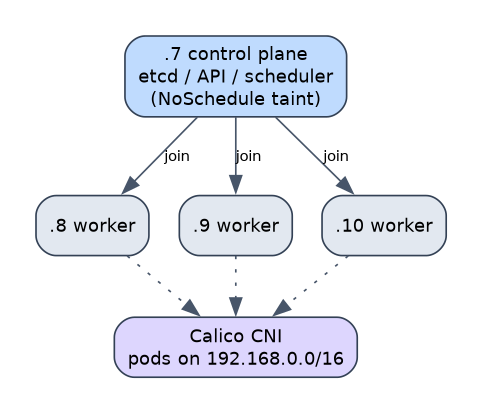
The cluster is four nodes: one control-plane node and three workers, all Ubuntu, running Kubernetes 1.36 with containerd as the runtime and Calico for networking.
Diagram
No comments to display
No comments to display