
Overview & Architecture
Redis ships with replication and a dedicated high-availability companion — Sentinel — but they are two separate pieces you assemble yourself. Replication alone gives you copies of your data; it does not promote a replica when the primary dies. Redis Sentinel is the part that watches the primary, agrees by quorum that it is down, promotes a replica automatically, and then tells your clients where the new primary is.
- Replication — one primary (read/write) and N replicas (read-only) kept in sync asynchronously.
- Sentinel — a separate process that monitors the primary and replicas, detects failure by quorum, runs the leader election, promotes a replica, and reconfigures the others to follow it.
- Sentinel-aware clients — applications ask any Sentinel "who is the master?" and connect there. When a failover happens they are notified and reconnect to the new primary — no proxy or virtual IP required.
Architecture
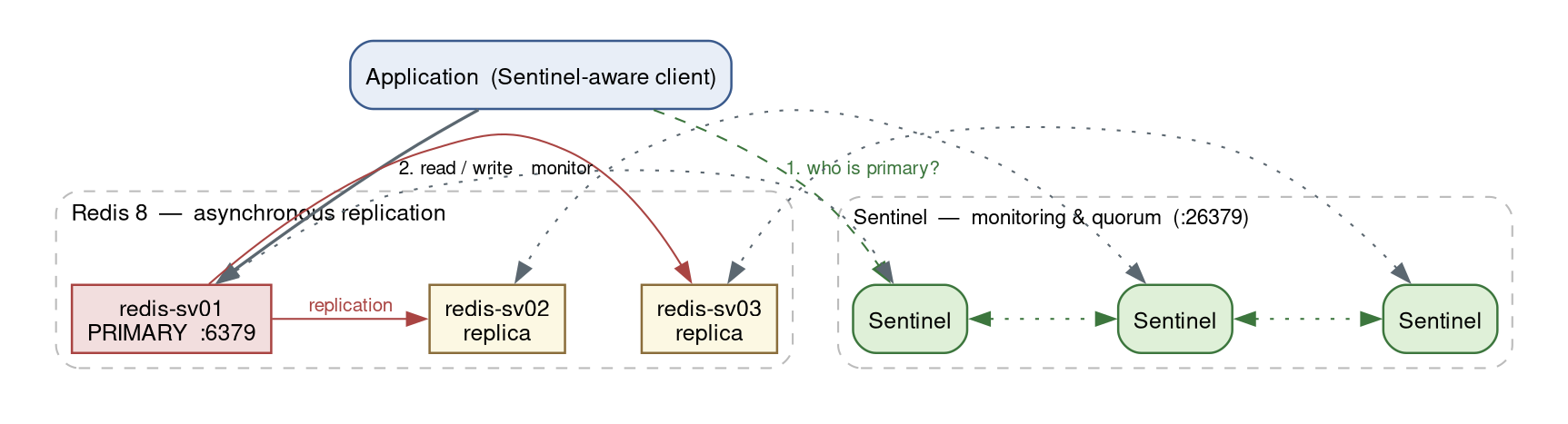
| Layer | Component | Role |
|---|---|---|
| Data | Redis 8 (primary + 2 replicas) | The keyspace + asynchronous replication |
| Detection & election | Redis Sentinel (3 instances) | Quorum, automatic promotion, reconfiguration |
| Discovery | Sentinel-aware client | Asks Sentinel for the current primary |
What we will build
A 3-node Redis cluster — one primary plus two replicas — where every node also runs a Sentinel:
redis-sv01,redis-sv02,redis-sv03— each runsredis-serverandredis-sentinel
Co-locating the Sentinels on the data nodes keeps the build to three machines while still giving Sentinel its required odd number (3) for quorum. Three is the minimum for a real cluster: a quorum of 2 survives the loss of one node, and the odd count avoids split-brain.
Why no load balancer? Unlike a database behind HAProxy, Redis clients are Sentinel-aware — they discover the primary directly. Putting a TCP proxy in front would hand clients a fixed address and defeat that discovery. The Sentinels are the routing layer.
The end result
When the primary fails, the Sentinels agree it is down, elect a leader among themselves, promote a replica, and reconfigure the rest — in a few seconds. Clients re-resolve the primary through Sentinel and carry on. We prove exactly that with a hard-kill failover test, and watch the old primary rejoin automatically as a replica.
Heads-up: every password in this guide is a placeholder. Replace them all with your own strong secrets before using this anywhere real.
No comments to display
No comments to display