
The ProxyJump pattern
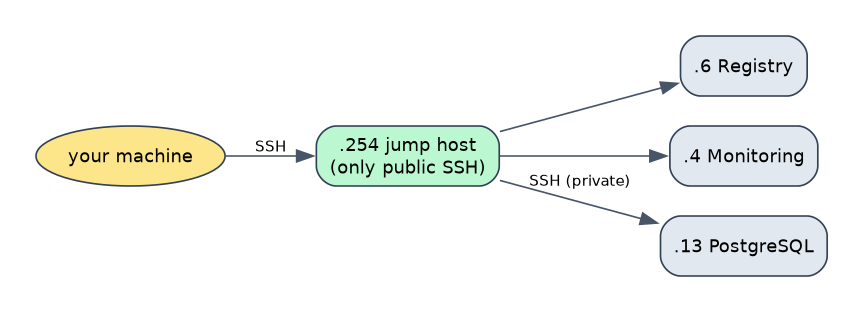
You don't want to manually SSH to the bastion and then SSH again — that's clumsy and breaks tooling. SSH has a built-in feature for exactly this: ProxyJump (and its lower-level cousin, ProxyCommand). It transparently tunnels your connection to the internal host through the bastion, in one command:
# conceptually:
ssh -J user@bastion  user@10.100.100.6      # land on the registry, via the jump host
To your terminal it feels like a direct connection; under the hood, the bastion is just forwarding the encrypted stream. The internal host's traffic never leaves the private network unencrypted, and you never have to think about the two-hop dance.
Everything administrative in this lab — every config change on an internal VM, every kubectl from a workstation, every database check — rode through the bastion this way. It's the connective tissue that makes a private-only network actually usable day to day.
Why we use this: ProxyJump means "bastion-only access" costs you nothing in convenience. The security benefit (one door) usually comes with a usability tax; ProxyJump pays that tax for you. There's rarely a good reason to expose SSH on every box once you've got this in your fingers.
Diagram
No comments to display
No comments to display